Cells, drugs and safety
Biophysical models of the myocyte, from ion channels to force generation, applied to drug action and safety, to sex hormones, and to carrying results from the laboratory to patients.
At the level of a single myocyte, ionic currents, calcium handling and crossbridge cycling determine the action potential and the force it produces. Models of those processes are used in pharmacological studies of the action potential. Models of the thick filament propose a mechanism for how the force a myocyte produces depends on its length, and are calibrated to measurements from human atrial and ventricular muscle.
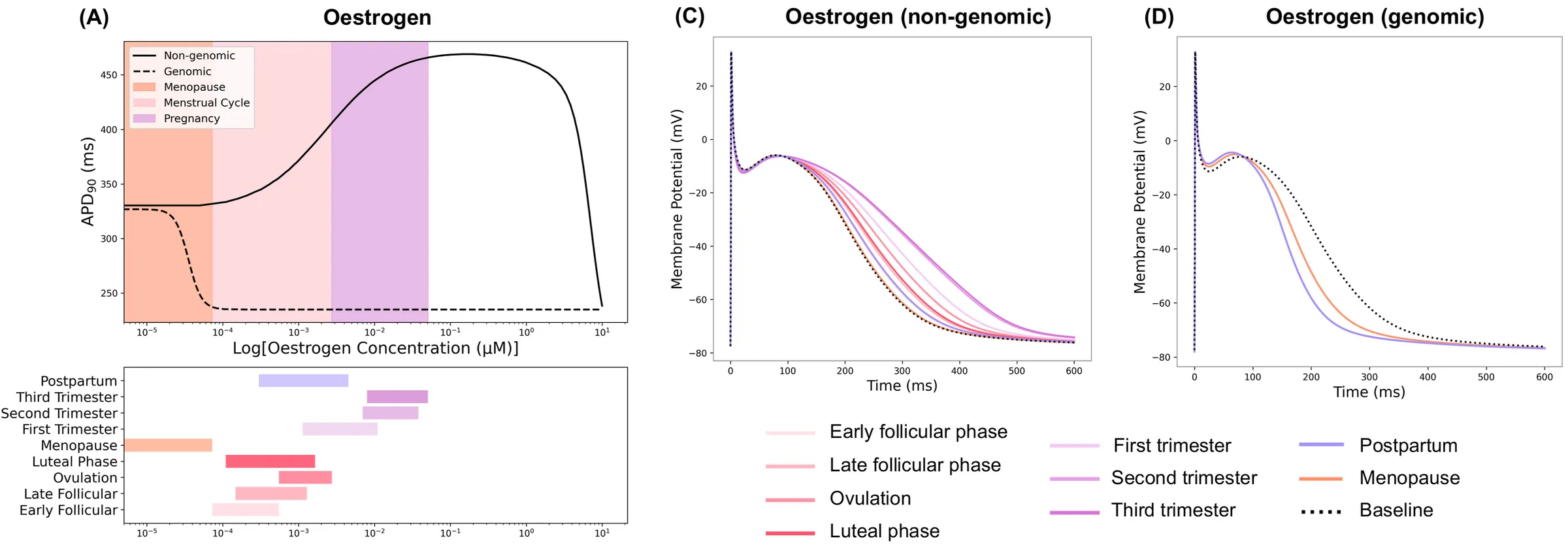
Atrial models are used to study how oestrogen alters the risk of atrial fibrillation, and computational models carry the effects of drugs on contraction and relaxation measured in rats over to humans. A model of the human fetal ventricular myocyte at ten weeks of gestation, calibrated to mRNA expression and experimental measurements, describes the ionic currents that govern fetal electrophysiology and calcium handling.
Recent papers
Multiscale modelling of hormonal effects on atrial fibrillation in female physiology
Influence of Oestrogen on Atrial Fibrillation Risk: An In-Silico Study
Cardiac length-dependent activation driven by force-dependent thick-filament dynamics
Modeling mechanisms of the thick-filament off-state dynamics in cardiac muscle