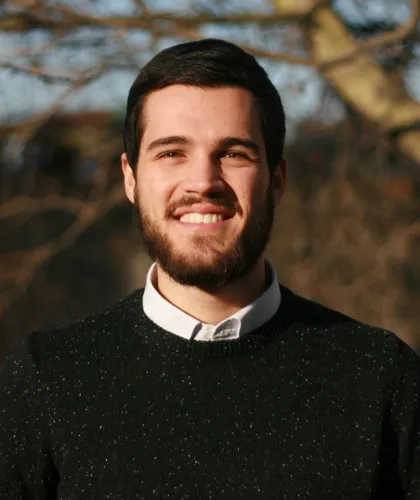
Stefano Longobardi
Stefano Longobardi graduated in Mathematics at Sapienza - University of Rome, Italy. He then obtained a Master’s Degree in Mathematics applied to Life Sciences from University of Trento, Italy, with final thesis project focused on a novel non-invasive technique to estimate the pressure jump inside blood vessels. From 2018 to 2022, Stefano did PhD in Biomedical Engineering at King’s College London, working on a multi-scale model of bi-ventricular rat hearts. He aims to identify drug molecular targets which are strongly linked to heart mechanics, in order to recover impaired left ventricle contractility function in pressure-overload-induced cardiac hypertrophic rat hearts. In order to do this, Stefano is employing computational models of cellular electrophysiology and calcium dynamics, sarcomere contraction and whole-organ mechanics, and lately some supervised learning techniques such as Gaussian processes and support vector machines. Along with his lifelong passion for mathematical formalism and abstract structures, Stefano has got a wide range of science-related interests including biology, quantum physics and astronomy. His next position was as quantitative systems toxicologist at GSK.
Papers
First author 5
Quantitative mapping of force–pCa curves to whole‐heart contraction and relaxation
The Journal of Physiology, 2022
PLoS Computational Biology, 2021
Lecture notes in computer science, 2021
Philosophical Transactions of the Royal Society A Mathematical Physical and Engineering Sciences, 2020
Biophysical Journal, 2020
Middle author 8
A model for the human fetal ventricular myocyte electrophysiology
PLoS Computational Biology, 2026
PLoS Computational Biology, 2023
Calibration of Cohorts of Virtual Patient Heart Models Using Bayesian History Matching
Annals of Biomedical Engineering, 2022
PLoS Computational Biology, 2022
Global Sensitivity Analysis of Four Chamber Heart Hemodynamics Using Surrogate Models
IEEE Transactions on Biomedical Engineering, 2022
Linking statistical shape models and simulated function in the healthy adult human heart
PLoS Computational Biology, 2021
Journal of Cardiovascular Electrophysiology, 2020
Cardiovascular Research, 2018
Last author 1
Modelling the Effects of Conductive Polymers and Stem Cells Derived Myocytes on Scarred Heart Tissue
Computing in cardiology, 2020