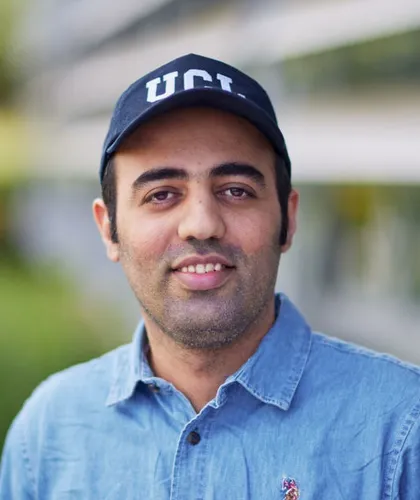
Shahrokh Rahmani
Dr. Shahrokh Rahmani completed his B.Sc., M.Sc., and PhD degrees in Mechanical Engineering-Biomechanics from Iran University of Science and Technology. Following this, he pursued his Postdoctoral Research at Technical University of Denmark where he focused on biomechanical modelling of biological soft tissue deformation. Dr. Rahmani then joined University College London as a Research Fellow in the mechanical engineering department, where he worked on dynamic whole organ modelling utilizing hierarchical Phase Contrast Tomography (HiP-CT) technique. He also developed image processing pipelines to handle the large datasets generated by this technique, and computational models of biological systems. From 2018, Dr. Rahmani has been working in the field of cardiovascular biomechanics, focusing on numerical modelling, experimental protocols, and image analysis pipelines to image large tissue volumes at high resolution.
Dr. Rahmani became a member of CEMRG in 2023, collaborating with researchers at the Victor Chang Cardiac Research Institute. His work involved MRI image-based modelling of the mechanical and structural function of the cardiovascular system under different pathologies, including alcoholic cardiomyopathy.
In 2025 he left to work for UCL.
Research themes
Papers
First author 1
Middle author 2
Journal of Molecular and Cellular Cardiology, 2026
PLoS Computational Biology, 2026