← Research

Mechanics, heart failure and devices

Electromechanical models of the failing and hypertrophied heart, and how pacing, resynchronisation and other treatments can be planned for a particular patient.
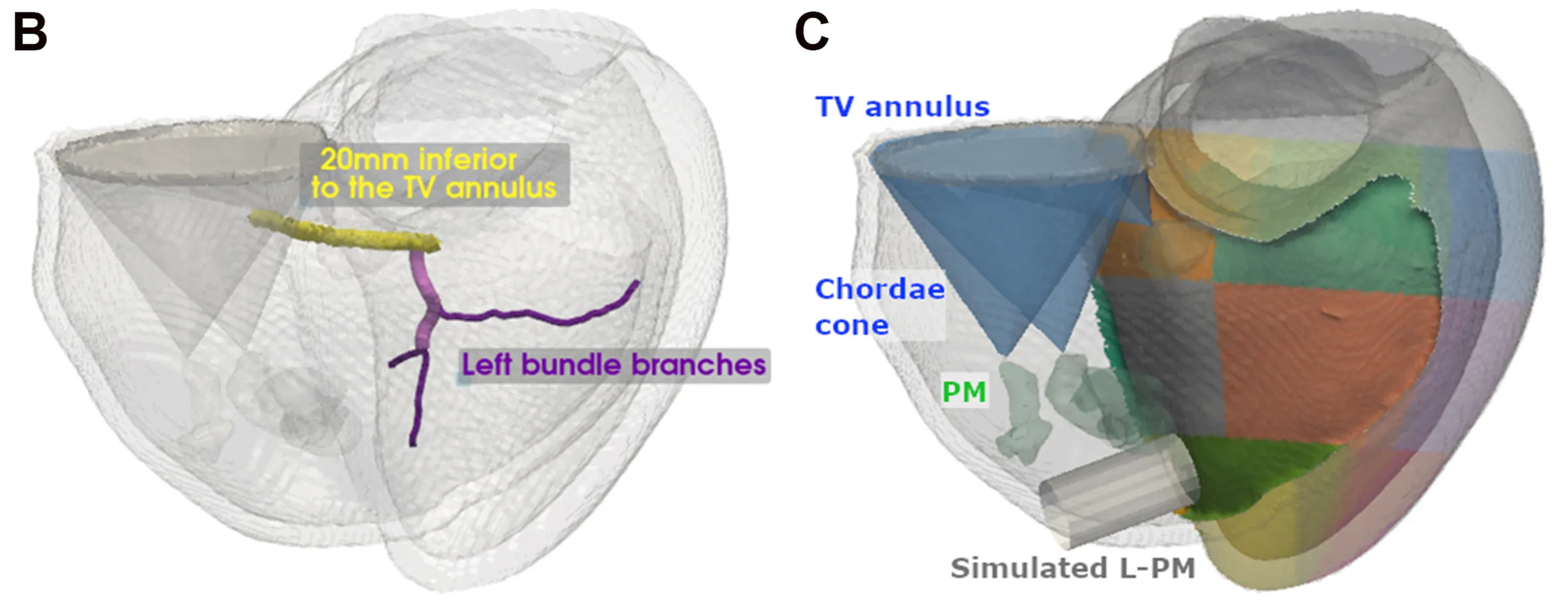
A biventricular mesh built from cardiac CT, with the tricuspid valve apparatus, the papillary muscles and an estimate of the left bundle branches (B), and with the American Heart Association regions mapped onto the left ventricular epicardium and the right ventricular septum, across which a leadless pacemaker is virtually implanted (C). Panels B and C of Figure 1 of Lee et al. (2026), Heart Rhythm O2, under CC BY 4.0.

Contraction couples electrical activation to pressure and flow. Electromechanical models of the failing heart are used to study how activation sequence, mechanical dyssynchrony and loading interact. Models of activation show how pacing changes the sequence: where a lead sits, how the delays are programmed, and what conduction system pacing does that biventricular pacing does not.

Four-chamber electromechanical models of hypertrophic cardiomyopathy show that functional remodelling, more than anatomy, changes what governs cardiac performance, and invasive pressure measurements are brought into the models alongside imaging. Reviews set out how digital twins could investigate the diabetic heart and its treatment, and how models could take in the stresses of daily life.

Recent papers

  1. Shuang Qian, Devran Ugurlu, Elliot Fairweather, …, Hassan Zaidi, …, Cristobal Rodero, Abdul Qayyum, …, Martin Bishop, Steven Niederer, npj Digital Medicine, 2026

    In silico trials for sex-specific patient inclusion criteria in cardiac resynchronization therapy

  2. Cristobal Rodero, Lara Curran, …, Abdul Qayyum, Rosie K. Barrows, Jose A. Solis-Lemus, Shahrokh Rahmani, Marina Strocchi, Angela W.C. Lee, Tiffany M.G. Baptiste, Ludovica Cicci, …, Elias Karabelas, …, Steven A. Niederer, Journal of Molecular and Cellular Cardiology, 2026

    Computational models show that functional remodeling, not anatomy, reshapes physiological determinants of cardiac performance in hypertrophic cardiomyopathy

  3. Shambhavi Malik, Ludovica Cicci, Abdul Qayyum, Rahul Ghelani, …, Steven A. Niederer, PLoS Computational Biology, 2026

    Body surface potential driven personalisation of electrophysiological digital twins in hypertrophic cardiomyopathy

  4. José Alonso Solís-Lemus, Rosie K. Barrows, Cristobal Rodero, Marina Strocchi, Natalie Montarello, …, Cesare Corrado, Abdul Qayyum, Shahrokh Rahmani, Caroline Roney, …, Steven A. Niederer, PLoS Computational Biology, 2026

    Assessing the importance of sex and disease-specific anatomy in electrophysiology and mechanical simulations with a newly developed public virtual cohort of four-chamber heart models

  5. Angela W.C. Lee, Marina Strocchi, Alphonsus Liew, …, Steven Niederer, Heart Rhythm O2, 2026

    Computational analysis of intracardiac collision risk and optimal site for right ventricular leadless left bundle branch area pacing: A simulation study

  6. Steven A Niederer, Maximilian Balmus, Christopher Burr, …, Sheng-Ya Wang, …, American Journal of Respiratory and Critical Care Medicine, 2026

    Digital twins for cardiopulmonary medicine: the case for pulmonary arterial hypertension

  7. Tiffany M.G. Baptiste, Cristobal Rodero, Charles P. Sillett, Marina Strocchi, Christopher W. Lanyon, …, Angela W. C. Lee, José Alonso Solís-Lemus, Caroline H. Roney, …, Steven A. Niederer, PLoS Computational Biology, 2025

    Regional heterogeneity in left atrial stiffness impacts passive deformation in a cohort of patient-specific models

  8. Marina Strocchi, Christoph M. Augustin, …, Steven A. Niederer, Journal of Biomechanical Engineering, 2025

    Integrating Imaging and Invasive Pressure Data into a Multiscale Whole-Heart Model

  9. Charles Sillett, Vitaliy Androshchuk, …, Tiffany M.G. Baptiste, Marina Strocchi, Jose Alonso Solis Lemus, Angela WC. Lee, Caroline H. Roney, …, Steven A. Niederer, Journal of cardiovascular computed tomography, 2025

    Three-dimensional left atrial strain from retrospective gated computed tomography: Comparison with speckle-tracking echocardiography in patients with aortic stenosis

  10. Marina Strocchi, Daniel J. Hammersley, …, Steven A. Niederer, Cardiovascular Diabetology, 2025

    Cardiac digital twins: a tool to investigate the function and treatment of the diabetic heart

  11. Alexandre Lewalle, Tiffany M. G. Baptiste, Rosie K. Barrows, Ludovica Cicci, Cesare Corrado, Angela W. C. Lee, Cristobal Rodero, José Alonso Solís-Lemus, Marina Strocchi, Steven A. Niederer, Biomechanics and Modeling in Mechanobiology, 2025

    Developing cardiac biomechanical models beyond the clinic: modeling stressors of daily life

  12. Steven Niederer, Henry Chubb, …, Nature Reviews Cardiology, 2025

    Leadless and extravascular cardiac resynchronization therapy: the future for CRT?