← Research

Digital twins and virtual cohorts

Models tied to one person's measurements, built for many people at once, so that questions can be asked of a population of hearts rather than a single example.

A digital twin is a model tied to one person’s measurements: their anatomy, their electrocardiogram, their pressures and volumes. Open tools build these models from cardiac MRI at scale, and representative ventricular meshes have been released from the patient-specific models of about 55,000 UK Biobank participants. Virtual cohorts of four-chamber hearts, including one of 50 hearts from clinical CT balanced by sex, are released for other groups to use.

Cohorts of twins are used to link anatomy to electrophysiological function across the adult population, and to run in silico trials of pacing strategies. A review sets out how twins could predict the response of a diabetic heart to treatment.

Recent papers

  1. Maximilian Balmus, Sheng‐Ya Wang, Edward W. G. Ashton, Rosie K. Barrows, Molly Monks, Yuzhang Ge, Arthur Lefebvre, Steven A. Niederer, Clinical Pharmacology & Therapeutics, 2026

    In Silico Clinical Trials in Drug Development: Virtual Patients, Applications, and Regulatory Convergence

  2. Shuang Qian, Devran Ugurlu, Elliot Fairweather, …, Hassan Zaidi, …, Cristobal Rodero, Abdul Qayyum, …, Martin Bishop, Steven Niederer, npj Digital Medicine, 2026

    In silico trials for sex-specific patient inclusion criteria in cardiac resynchronization therapy

  3. Shambhavi Malik, Ludovica Cicci, Abdul Qayyum, Rahul Ghelani, …, Steven A. Niederer, PLoS Computational Biology, 2026

    Body surface potential driven personalisation of electrophysiological digital twins in hypertrophic cardiomyopathy

  4. José Alonso Solís-Lemus, Rosie K. Barrows, Cristobal Rodero, Marina Strocchi, Natalie Montarello, …, Cesare Corrado, Abdul Qayyum, Shahrokh Rahmani, Caroline Roney, …, Steven A. Niederer, PLoS Computational Biology, 2026

    Assessing the importance of sex and disease-specific anatomy in electrophysiology and mechanical simulations with a newly developed public virtual cohort of four-chamber heart models

  5. Steven A Niederer, Maximilian Balmus, Christopher Burr, …, Sheng-Ya Wang, …, American Journal of Respiratory and Critical Care Medicine, 2026

    Digital twins for cardiopulmonary medicine: the case for pulmonary arterial hypertension

  6. Tiffany M. G. Baptiste, Rosie K. Barrows, Cristobal Rodero, Steven A. Niederer, Frontiers for Young Minds, 2025

    Testing Treatments Virtually: How Digital Hearts can Save Lives

  7. Tiffany M.G. Baptiste, Cristobal Rodero, Charles P. Sillett, Marina Strocchi, Christopher W. Lanyon, …, Angela W. C. Lee, José Alonso Solís-Lemus, Caroline H. Roney, …, Steven A. Niederer, PLoS Computational Biology, 2025

    Regional heterogeneity in left atrial stiffness impacts passive deformation in a cohort of patient-specific models

  8. Marina Strocchi, Daniel J. Hammersley, …, Steven A. Niederer, Cardiovascular Diabetology, 2025

    Cardiac digital twins: a tool to investigate the function and treatment of the diabetic heart

  9. Devran Ugurlu, Shuang Qian, Elliot Fairweather, …, Marina Strocchi, …, Steven Niederer, Martin Bishop, PLoS ONE, 2025

    Cardiac digital twins at scale from MRI: Open tools and representative models from ~ 55000 UK Biobank participants

  10. Shuang Qian, Devran Ugurlu, Elliot Fairweather, …, Marina Strocchi, Ludovica Cicci, …, Hassan Zaidi, …, Martin Bishop, Steven Niederer, Nature Cardiovascular Research, 2025

    Developing cardiac digital twin populations powered by machine learning provides electrophysiological insights in conduction and repolarization

  11. Marina Strocchi, Cristobal Rodero, Caroline H. Roney, Caroline Mendonca Costa, Gernot Plank, …, Steven A. Niederer, Methods in molecular biology, 2023

    A Semi-automatic Pipeline for Generation of Large Cohorts of Four-Chamber Heart Meshes

  12. Marina Strocchi, Nadeev Wijesuriya, …, Steven A. Niederer, Journal of Cardiovascular Translational Research, 2023

    Computational Modelling Enabling In Silico Trials for Cardiac Physiologic Pacing
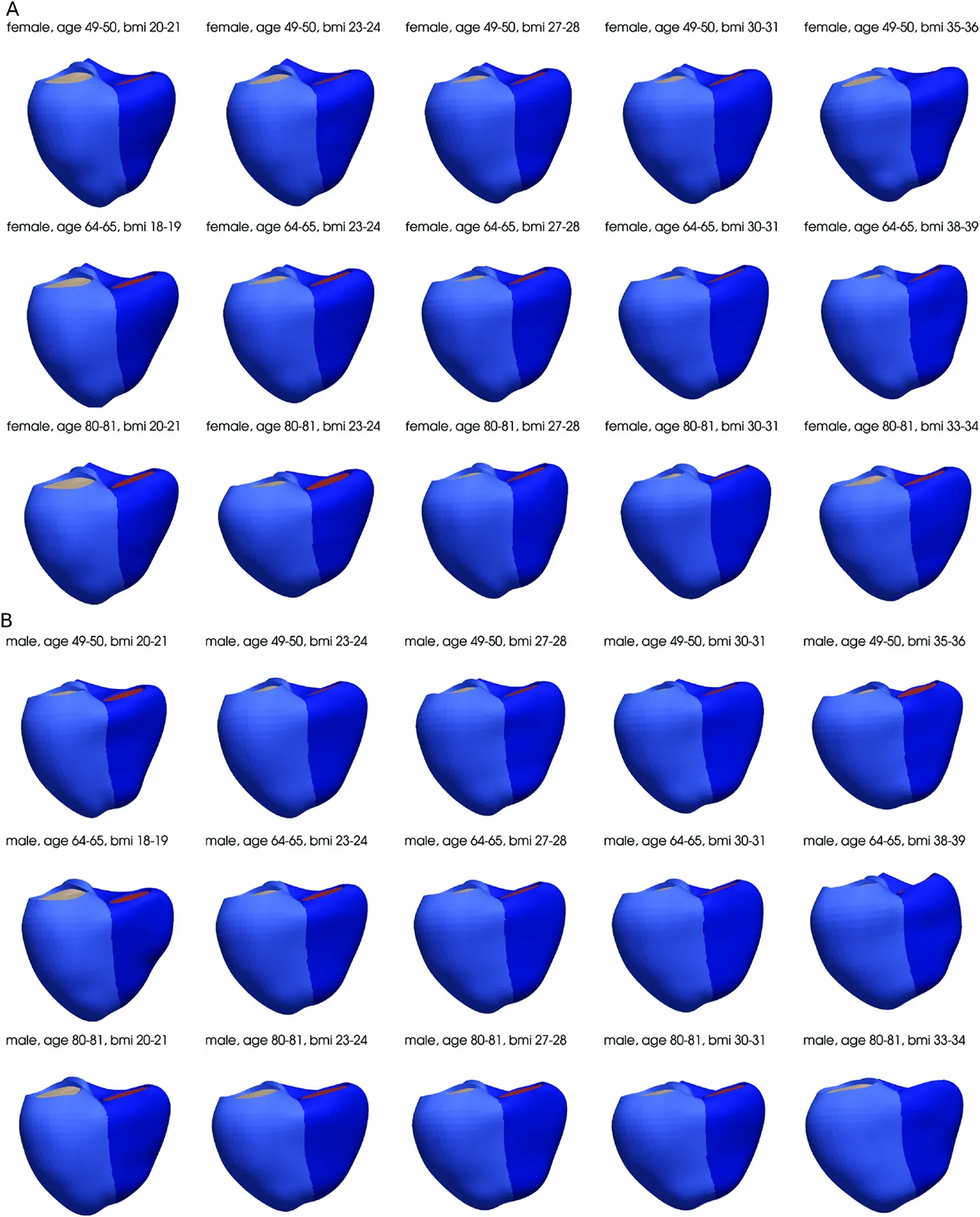
Representative biventricular meshes for different groups of age, sex and body mass index, built from the cardiac MRI of about 55,000 UK Biobank participants. Figure 5 of Ugurlu et al. (2025), PLOS ONE, under CC BY 4.0.