← Research

Ventricular arrhythmia and risk

Why dangerous ventricular rhythms arise in scarred and remodelled hearts, which regions of a particular heart can sustain them, and where an ablation should be aimed.
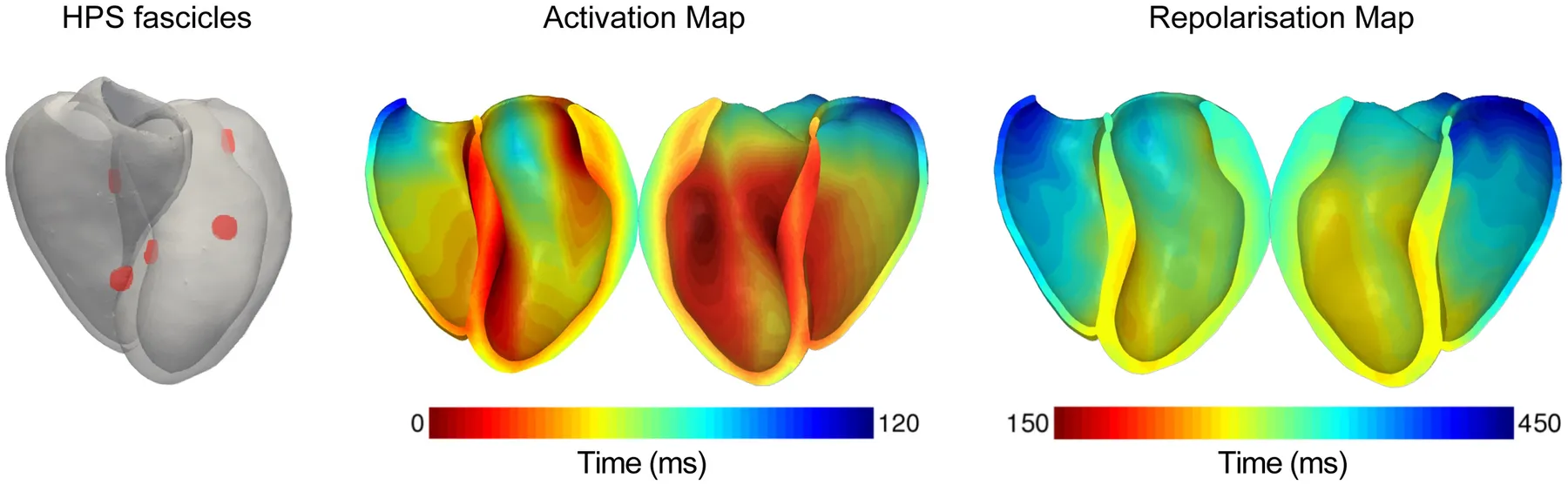
A patient-specific model of the ventricles with the early activation sites of its conduction system (left), and its activation and repolarisation maps (centre and right). Figure 4 of Malik et al. (2026), PLOS Computational Biology, under CC BY 4.0.

Scar and remodelling create the conditions for reentry in the ventricles. Simulation of the whole ventricle shows which regions can sustain a circuit, and whether an arrhythmia would be inducible in a particular heart. These predictions are tested against how the scar is reconstructed from the images, and scar is detected in routine CT with machine learning.

Personalised electrophysiology models are also calibrated to the 12-lead electrocardiogram and to body surface potentials recorded with electrode vests, including in hypertrophic cardiomyopathy, a genetic disease that carries a risk of sudden cardiac death. Fetal arrhythmias can lead to stillbirth, and a model of the human fetal ventricular myocyte gives a basis for studying them.

Recent papers

  1. Cristobal Rodero, Lara Curran, …, Abdul Qayyum, Rosie K. Barrows, Jose A. Solis-Lemus, Shahrokh Rahmani, Marina Strocchi, Angela W.C. Lee, Tiffany M.G. Baptiste, Ludovica Cicci, …, Elias Karabelas, …, Steven A. Niederer, Journal of Molecular and Cellular Cardiology, 2026

    Computational models show that functional remodeling, not anatomy, reshapes physiological determinants of cardiac performance in hypertrophic cardiomyopathy

  2. Shambhavi Malik, Ludovica Cicci, Abdul Qayyum, Rahul Ghelani, …, Steven A. Niederer, PLoS Computational Biology, 2026

    Body surface potential driven personalisation of electrophysiological digital twins in hypertrophic cardiomyopathy

  3. Cesare Corrado, Caroline H. Roney, Sanjiv M. Narayan, …, Steven A. Niederer, Communications Medicine, 2025

    The effect of clinically relevant changes in extracellular electrolyte concentrations on human atrial arrhythmias

  4. Abdul Qayyum, Imran Razzak, …, Steven A Niederer, Information Fusion, 2024

    Unsupervised unpaired multiple fusion adaptation aided with self-attention generative adversarial network for scar tissues segmentation framework

  5. Marina Strocchi, Karli Gillette, …, Steven A. Niederer, Journal of Cardiovascular Electrophysiology, 2023

    Effect of scar and His–Purkinje and myocardium conduction on response to conduction system pacing

  6. Damiano Fassina, Caroline M. Costa, Martin Bishop, Gernot Plank, …, Steven A. Niederer, Computers in Biology and Medicine, 2023

    Assessing the arrhythmogenic risk of engineered heart tissue patches through in silico application on infarcted ventricle models

  7. Cesare Corrado, Caroline H. Roney, Orod Razeghi, Josè Alonso Solís Lemus, Sam Coveney, …, Steven A. Niederer, Computers in Biology and Medicine, 2023

    Quantifying the impact of shape uncertainty on predicted arrhythmias