Atrial fibrillation and ablation
Mechanisms that start and sustain atrial fibrillation, which patients an ablation will help, and how it can be targeted for a particular atrium rather than a generic one.
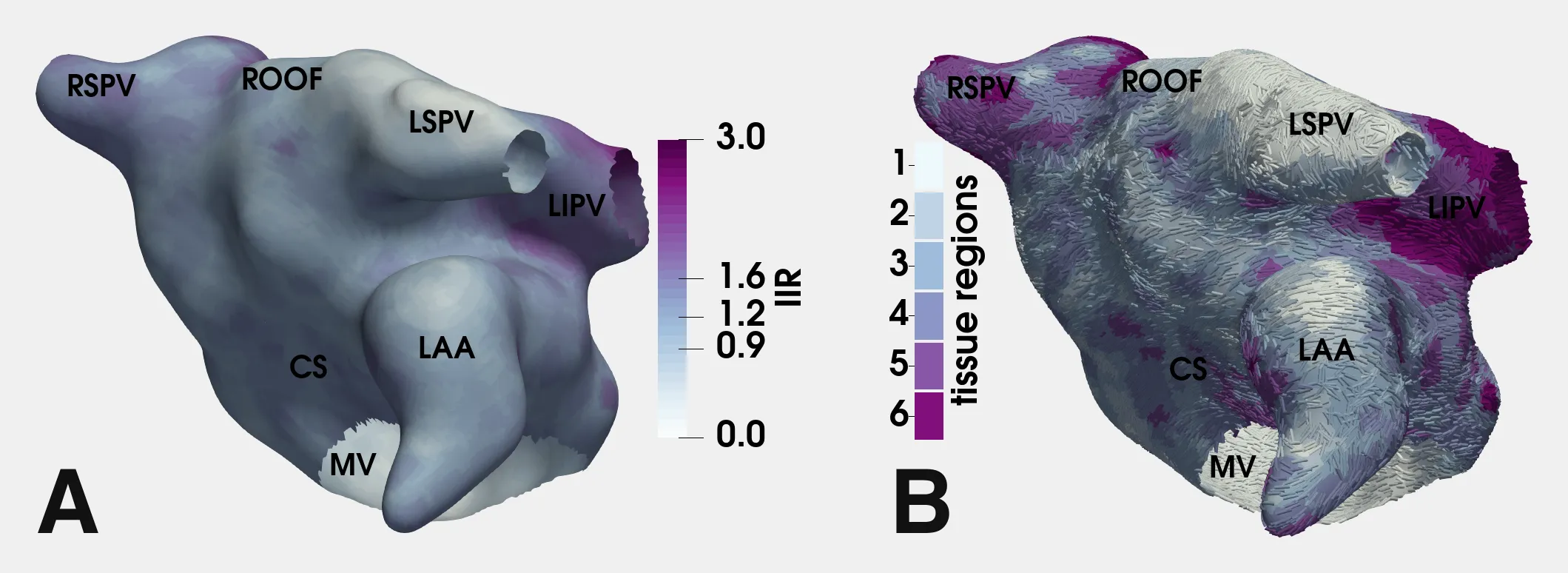
Atrial fibrillation begins and persists through a combination of triggered activity and a substrate that lets reentry survive. Models built on a patient’s own atrial anatomy, fibrosis and electroanatomical maps are used to study how that substrate behaves, and to test where ablation would have to be placed to change it.
Atrial models, combined with population data, are used to predict whether atrial fibrillation recurs after ablation. Other work measures the motion and strain of the left atrium from gated CT, relates regional strain to fibrosis and regional stiffness to deformation, and studies how electrolyte concentrations and oestrogen alter the risk of arrhythmia, and whether restoring rhythm benefits the left ventricle.
Recent papers
Multiscale modelling of hormonal effects on atrial fibrillation in female physiology
Influence of Oestrogen on Atrial Fibrillation Risk: An In-Silico Study
Is regional atrial strain a useful surrogate of regional atrial fibrosis in atrial cardiomyopathy?
Assessment of Left Atrium Motion Deformation Through Full Cardiac Cycle