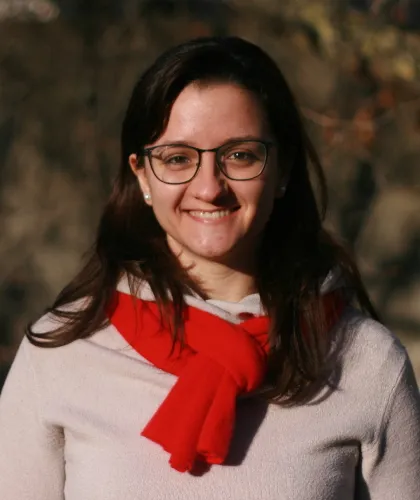
Marina Riabiz
Marina Riabiz received her undergraduate and master’s degree in Mathematical Engineering from Politecnico di Milano, Italy, specializing in Applied Statistics. Her PhD thesis “On Latent Variable Models for Bayesian Inference with Stable Distributions and Processes” was in Information Engineering, at the University of Cambridge, UK, where she was supervised by Prof. Simon Godsill.
She joined the CEMRG group in October 2018, and she worked on uncertainty quantification for myocytes models, under the guidance of Prof. Steven Niederer. She developed Monte Carlo methods for Bayesian parameter inference in dynamical systems describing calcium transients and their contribution to the action potential in rat cell models. The main goal of her project was to capture the variability of and covariance between calcium handling proteins, the main challenge being the high dimensionality of the parameter space to be inferred. The project was in collaboration with Prof. Chris Oates and other researchers form the Alan Turing Institute. Marina’s broader research interests are at the intersection of probabilistic machine learning, statistics and signal processing, applied to medical data. After leaving CEMRG in 2022, she started her role as lecturer in Statistics at King’s College London.
Papers
First author 2
Novel developments in inferring variability and co-variability of calcium signalling
Journal of Molecular and Cellular Cardiology, 2022
Optimal Thinning of MCMC Output
Journal of the Royal Statistical Society Series B (Statistical Methodology), 2022
Middle author 1
Creation and application of virtual patient cohorts of heart models
Philosophical Transactions of the Royal Society A Mathematical Physical and Engineering Sciences, 2020